


There’s nothing like fog for a bit of mystery, atmosphere and an impeded view of the roads. It’s one of several weather patterns you’ll deal with as a driver, and can be dangerous if not approached with care.
Understandably, the Highway Code talks a lot about driving in a pea souper, and so does the law. You should, for instance, always have your normal dipped headlights on when visibility is poor—but when should you pair them with fog lights, and when could this land you in trouble?
Fog lights

By law, all cars driven in the UK must have rear fog lights, which are red and mounted below your brake lights. They help other drivers to pick you out in poor visibility. Many cars also boast front fog lights. Their low position and how they’re angled will help to extend your vision without light reflecting back at you—as can happen with full-beam headlights.
The law (The Road Vehicles Lighting Regulations 1989, to be specific) instructs us that drivers may only use their fog lights:
- When they wouldn’t cause “undue dazzle or discomfort” to other road users.
- “In conditions of seriously reduced visibility”
The Highway Code explains, in Rule 226, that this means that you can’t see more than 100m (328 feet) ahead. If you’re struggling to visualise that sort of distance, it’s about the length of a football pitch.
And
- When driving
In other words, you can’t keep your fog lights lit when you’re parked up, unless in an emergency.
When should you turn your fog lights on?
100 metres equates to a little less than eight seconds when you’re travelling at 30mph. At that speed, you can test your visibility by setting your eyes on something immovable you can just make out in the distance—a road sign, building or streetlight—and counting the seconds until you pass it. The object is over 100m away if you take over eight seconds. Otherwise, pop them on for a better view.
What happens if you use fog lights inappropriately?

You could get a Fixed Penalty Notice, or fine, if you use your fog lights inappropriately. For instance, if you switch them on:
- As a substitute for another broken light
- On clear nights to aid vision
- When visibility isn’t poor enough to warrant their use
That’s because they can dazzle other drivers and impede their vision. Rear fog lights can also “obscure your brake lights” (rule 236, Highway Code), so other road users might not notice when you’re slowing down.
So if you have been travelling through a patch of heavy fog, remember to turn your fog lights off as soon as visibility improves.
How to turn on your fog lights
There are different controls in every car. Here are some examples:
Rear fog light symbol

Front fog light symbol

Chances are, you’ll have to turn a knob, twist a stalk, or pull/push a button to activate your fog lights. If you can’t find them, check out your vehicle handbook.
What else should you do to drive safely in foggy weather?
As well as making yourself more visible, the Highway Code has plenty of top tips for driving safely through fog.
Use your demisters and windscreen wipers

Make sure your windows are clear before you drive. Use your demisters, with the heat directed at your windscreen and wipers. You might need to keep these running as you drive to make sure they don’t mist up again.
Reduce your speed
The Met Office has compiled a whole heap of interesting facts about fog—but the most important to us, as drivers, is that many people inadvertently speed up in foggy weather. That’s because a lot of our speed perception is determined by how quickly we pass objects, such as trees and buildings (and is also why some roads use ‘two chevrons apart’ markings to slow people down).
When fog reduces visibility, our surroundings become a lot more blurry, distorting our judgement and giving us the idea that we’re driving more slowly than is actually the case. So, in order to stay safe, keep an eye on your speedometer.
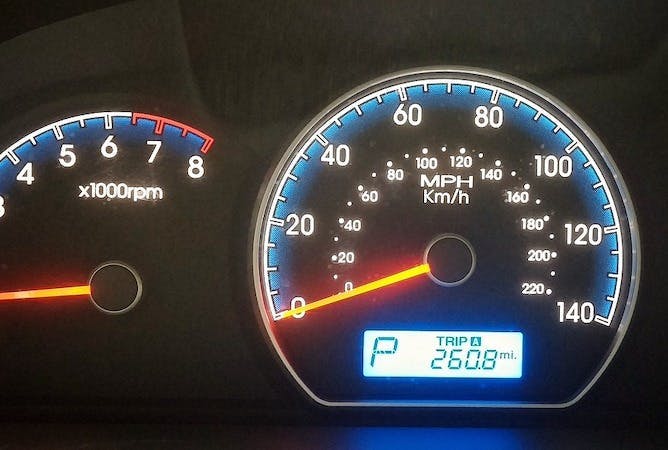
The reduced visibility and likelihood of wet roads mean you should slow down when it’s foggy. Make sure you:
- Check your mirrors then slow down before entering fog
- Use your brakes to reduce your speed (rather than simply de-accelerating) to warn other drivers that you’re slowing down
- Increase the distance between yourself and the vehicle in front
- Can stop safely within the distance you can see clearly
- Keep to a safe speed even if another driver is travelling too closely behind you
Watch out for other drivers
Not everyone will have thought to put on their fog lights, and some people may even have forgotten to light their headlights. Drive cautiously and stay alert for signs of movement.
Maintain a good road position
In adverse weather conditions, it’s especially important to continue following good general driving principles. Keep to your lane and make sure you’re in the right position when pulling up at junctions.
Utilise all your senses
If you can’t see, then you might be able to hear. At junctions, wind down your windows so that you can listen out for traffic.
Be cautious, but decisive
Only pull out when you’re sure it’s safe. But once you’ve made that decision, don’t hang about unnecessarily: undue hesitation could lead to someone driving into the side of you.
Checklist before driving in the fog

- Make sure you know how to turn on both your front and rear fog lights
- Check your fog lights are working by turning them on and either walking around the car or using a reflective surface, like a window, to see that they’re lit
- Consider whether you really need to drive in these conditions
FAQs
Full-beam headlights are really bright and are angled to give you a clearer view of the road ahead. However, you should never use them in foggy weather because the fog will reflect the light back to you, making it even more difficult to see. Instead, stick to dipped headlights and fog lights, when you can’t see more than 100m in front of you.
Heavy fog might cause your practical test to be cancelled, as the conditions may be deemed too dangerous. If you’re worried about the weather on the day of your test, keep an eye on your emails and get in touch with the test centre (find their details on your booking confirmation), who will tell you whether your practical is still going ahead.
Never just assume your test is cancelled, though; sometimes fog is very localised, and just because there are adverse conditions where you are, doesn’t mean the test route is necessarily affected.
If your test is cancelled, you’ll automatically be given another date.
Freezing fog is where droplets of below 0º water form in the air, turning to ice when they hit a surface—such as your windscreen. It isn’t all that common at ground level, but it does happen occasionally, so you need to make sure you know how to clear your windscreen effectively using your demisters and heat settings. You can also protect it overnight using a windscreen cover.
We'd love to let you know about our courses, news and offers via email. You may unsubscribe at any time.